According to Gartner, the most successful software engineering teams get results:
53%
superior in terms of experience and productivity of their employees
37%
superior in terms of attraction and loyalty of their customers
Technical coaching responds to the challenges of companies who want to transform themselves sustainably by acting on 4 dimensions:
Team
More engagement, sharing, collaboration
Management
More visibility and better cost control
Organization
Culture of continuous improvement
External
Greater value added by the products developed
So that your teams regain full mastery of their code and of their pipeline:
We instill a culture of continuous improvement within teams and increase their skills in their development practices
We work in immersion in the teams and develop with them the functionalities of the backlog directly on their code base
Greater mastery to make delivery more reliable
Feedback loop is reduced
Delivery processes are improved
Continuous improvement is maintained
Greater mastery to foster systemic impact
The teams share their knowledge with passion
The outreach within the organization captures talents and new projects
The quality of the products developed attracts and retains more customers
With several levels of support and intervention formats
Team coaching
Learning Hours
Learn and implement new practices through training (kata, etc.)
Mob Programming (whole or part team)
Develop a backlog functionality by applying the best practices seen during the learning hours
Individual coaching
Pair Programming
Solve problems encountered during Mob sessions or to deepen specific practices
With a focus on people to gain autonomy
To promote acceptable and sustainable skills development, we alternate:
“in” cycles: where the coach is immersed in the team
“out” cycles: where the coach temporarily fades away
“IN” CYCLE
The technical coach accompanies the team in a coaching session (collective or individual)
“OUT” CYCLE
The technical coach lets the team experiment for themselves
The cycles follow the rhythm of the team (on 1 or 2 sprints depending on the duration or on the Program Increment if it exists).
At each start of the immersion cycle, the coach and the team agree on a coaching contract which will define the scope of intervention and the objectives to be achieved.
Note that although it has an impact on team delivery, the technical coach does not take development tasks individually.
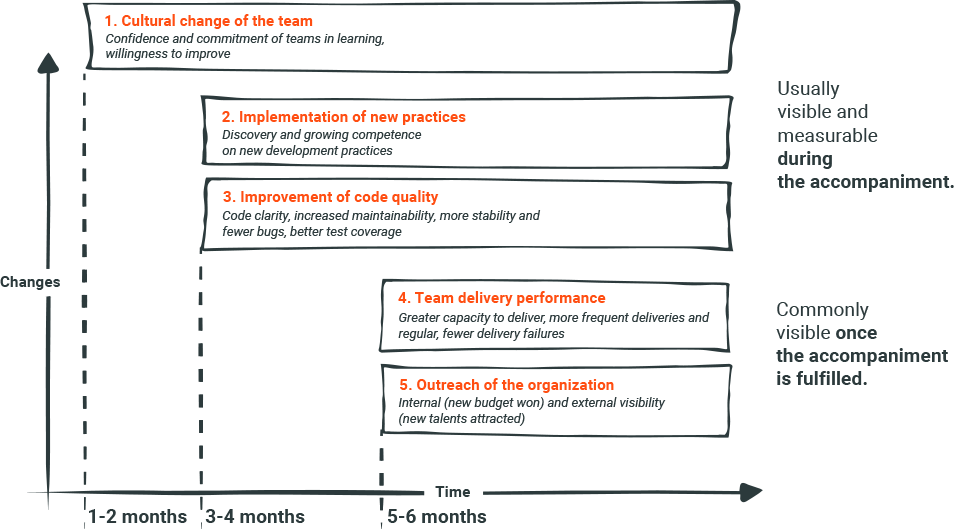
It is measured during and after technical coaching accompaniment
Accompaniment lasts between 6 months and 1 year depending on the scope of intervention.
The ability of teams to deliver is improved
A cultural change is taking place within the team
The team is upskilling on its development practices
The team has more commitment and greater autonomy
The passion of the teams is recovered
Mastery reinforces commitment
The teams share their experience and the value acquired through what they learned
A culture of improvement is establishing over the long term